Precision AquaTarp application supporting TSF compliance with safer, scalable dust control at less than half the application cost of traditional aerial methods*
Project Overview:
Application: Tailings dam dust suppression and compliance management
Technology: Drone-based spray application
Product: AquaTarp dust control membrane
Industry: Mining & mineral processing
Client: Confidential (Australia)
Key Outcome: Application costs typically less than half of traditional aerial methods*
Background:
Dust generation from tailings storage facilities (TSFs) is a well-recognised compliance and operational challenge across the mining industry. Large exposed surfaces of fine particulate material are highly susceptible to wind erosion, leading to:
- Airborne dust emissions and reduced air quality
- Environmental compliance risks
- Loss of valuable fines
- Increased community and stakeholder concerns
Traditional dust suppression methods can struggle to deliver consistent performance across TSFs due to:
- Large surface areas
- Limited accessibility
- Variable surface conditions
- Operational and safety constraints
Our client, an Australian TSF, required a safe, scalable and more cost-effective solution to manage dust-related compliance risk across large and complex tailings surfaces, with minimal disruption to operations.
The Challenge:
Limitations of Conventional Methods
1. Water Carts
- Unable to safely access soft or unstable tailings surfaces
- High water consumption with short-lived effectiveness
- Frequent reapplication required
- Increased safety risks for operators
2. Fixed Reticulation Systems
- Risk of channel formation and ponding, leading to uneven treatment
- High capital and maintenance costs
- Limited flexibility across changing tailings conditions
- Reduced effectiveness on fine particulate surfaces
3. Manned Aircraft (Planes / Helicopters)
- High mobilisation and operating costs
- Long turnaround times due to refuelling and logistics
- Inconsistent application caused by altitude, wind drift and turbulence
- Restrictions due to terrain, infrastructure and airspace
- Limited scalability under time constraints
Together, these constraints can drive up the total cost of dust control while making it more difficult to maintain consistent coverage and manage dust-related compliance obligations.
The Solution:
Dust-A-Side Australia combined precision drone application with our proprietary AquaTarp dust control membrane to deliver consistent coverage across large and difficult-to-access tailings surfaces, helping the site manage dust-related compliance risk while reducing the cost and complexity associated with conventional application methods.
Drone-Based Application Technology:
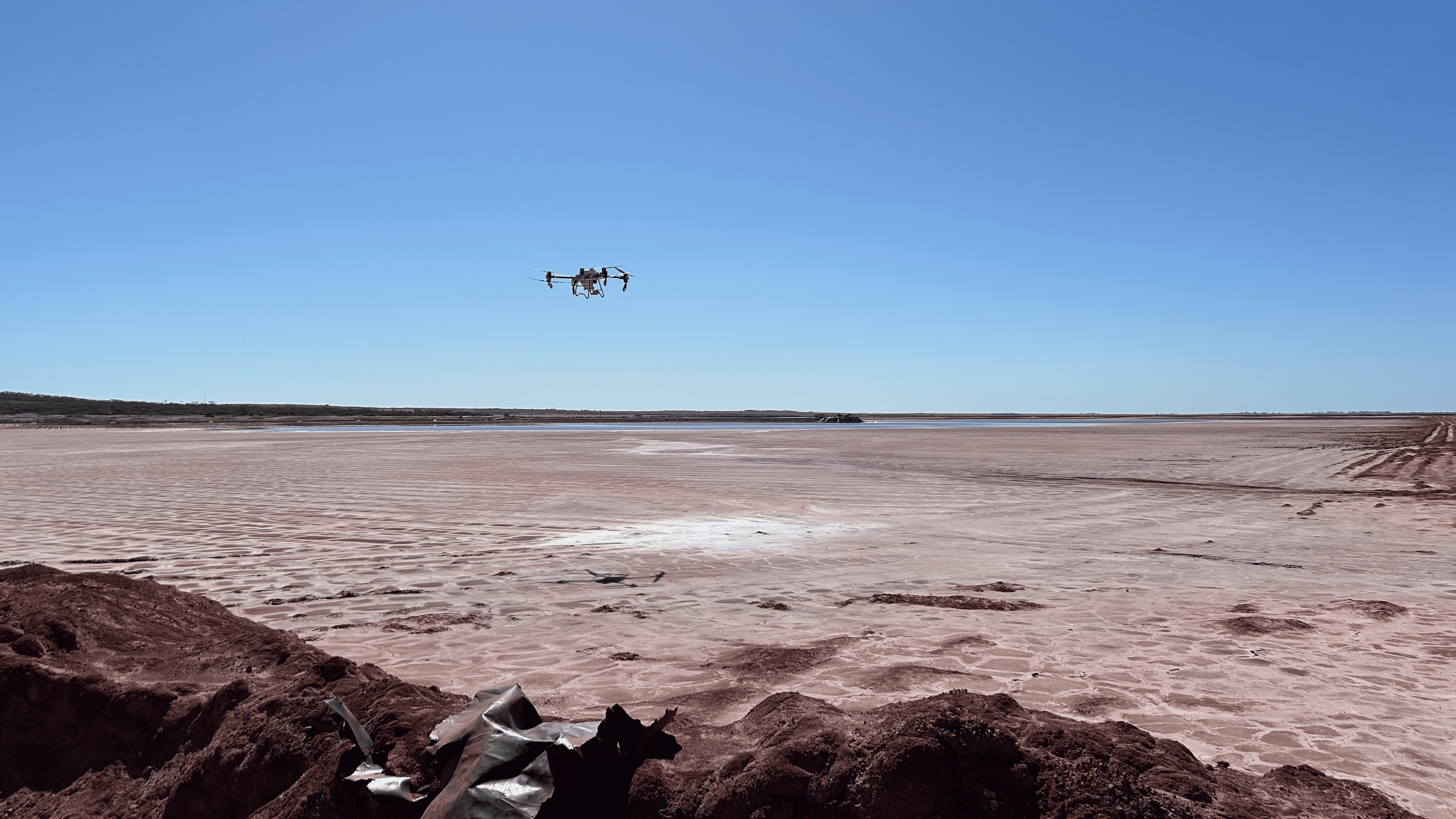
The use of drones enables low-altitude, precision spraying, ensuring consistent and controlled application across large tailings surfaces.
Key Features:
-
Pre-programmed flight paths for accurate and repeatable coverage
-
Low-altitude operation to minimise wind drift
-
Rapid mobilisation with minimal site infrastructure requirements
-
Fast turnaround between cycles (battery swap and refill)
-
Scalable deployment using multiple drones
This approach allows for uniform application while significantly reducing operational complexity and cost.
AquaTarp Dust Control & Compliance Support:
AquaTarp is a spray-applied surface stabilisation product designed specifically for fine particulate materials such as tailings.
Performance Characteristics:
- Forms a flexible, cohesive membrane that binds surface particles
- Maintains performance through wetting and drying cycles
- Effective for up to 12 months, depending on environmental conditions
- Reduces wind erosion and visible dust emissions
- Supports environmental compliance objectives
When applied via drone, AquaTarp achieves consistent thickness and surface coverage, maximising its long-term effectiveness.
Implementation:
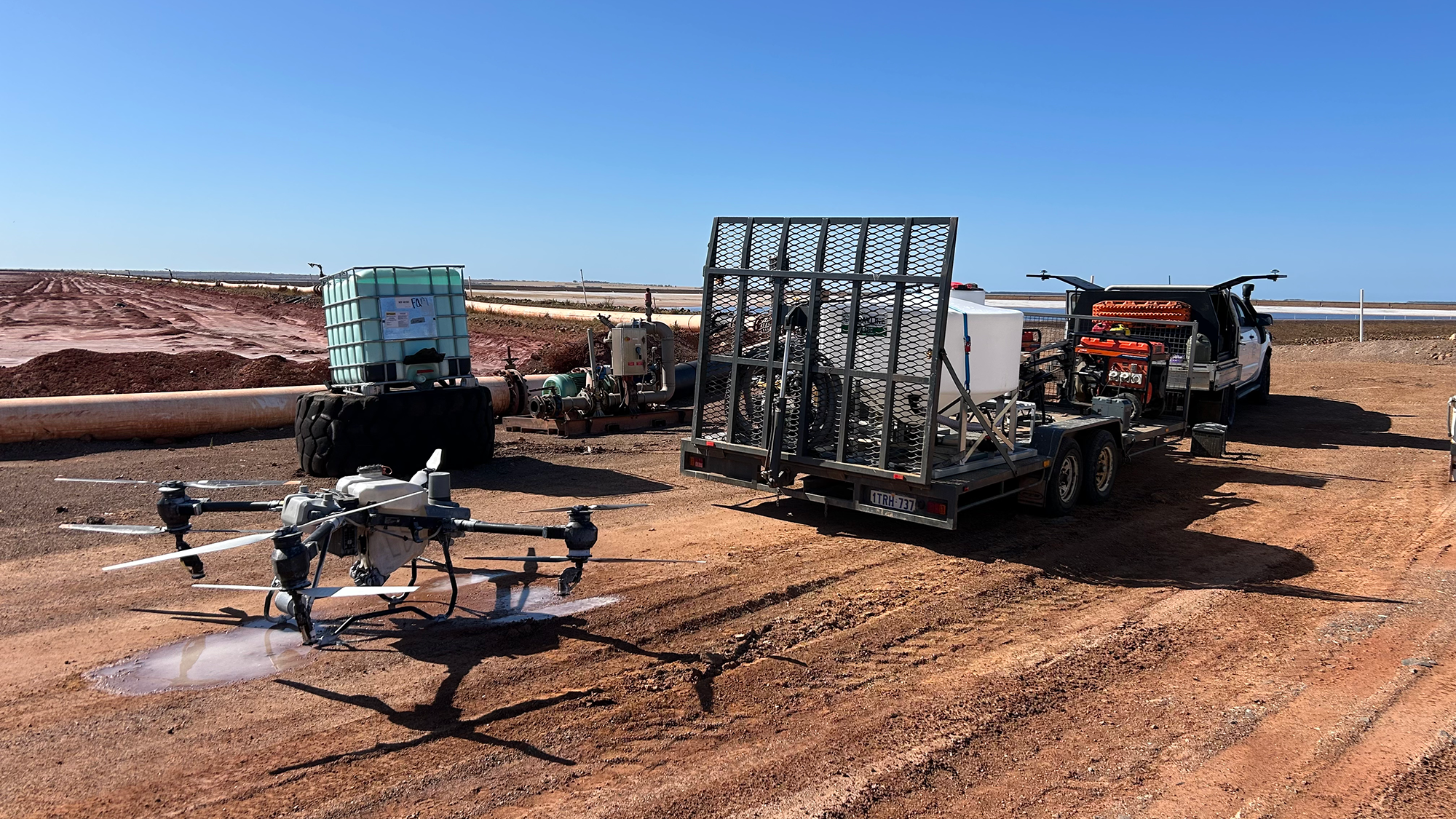
The system was deployed directly adjacent to the application area, removing the need for infrastructure such as runways or fixed spray systems. Pre-programmed flight planning, sequential application zones and efficient battery and refill cycles enabled continuous, controlled application with minimal downtime.
Results & Compliance Outcomes:

Operational Performance
- Uniform membrane coverage across large tailings areas
- Significant reduction in visible dust emissions
- Improved control of wind-blown fines
Cost Efficiency
- Application costs typically less than half of traditional aerial methods
- Reduced labour and mobilisation requirements
- Lower total project cost
Water & Resource Efficiency
- Reduced water usage compared to conventional suppression methods
- Optimised product application with minimal waste
Compliance, Health, Safety & Environment
- Supports management of dust-related environmental compliance risk
- Eliminated need for personnel to access hazardous tailings surfaces
- Reduced operator exposure to dust
- Improved air quality and site conditions
- Minimised off-site dust migration
Project Delivery
- Faster mobilisation and application timelines
- High flexibility to respond to changing site conditions
- Scalable deployment to meet time constraints
Comparison of Dust Control Methods:
| Comparison of Dust Control Methods | Key consideration |
| Water carts | Access limitations, repeated application and high water demand |
| Fixed reticulation | Infrastructure requirements and limited flexibility |
| Manned aircraft | Higher mobilisation/application cost and logistical constraints |
| Drone application | Precision coverage, rapid mobilisation and scalable deployment |
Conclusion:
This project demonstrates that managing tailings dust for compliance does not have to come with the cost, infrastructure and operational constraints associated with traditional application methods.
By combining AquaTarp with precision drone technology, Dust-A-Side Australia delivered uniform dust control across a challenging TSF, supporting environmental compliance objectives while reducing water and resource requirements, eliminating the need for personnel to access hazardous tailings surfaces, and achieving application costs typically less than half those of traditional aerial methods.*
For sites where conventional dust suppression is costly, difficult to deploy or ineffective, drone-applied AquaTarp provides a scalable alternative that supports both compliance and operational efficiency.
Contact:
For more information on drone-based tailings dust control, compliance applications or AquaTarp solutions, contact:
Dust-A-Side Australia
Click here to request a consultation
Or call 1800 662 387.
*Application costs were typically less than half those of traditional aerial methods for the referenced Australian application. Actual costs may vary according to site and application requirements.
**Effectiveness of up to 12 months depends on environmental conditions.